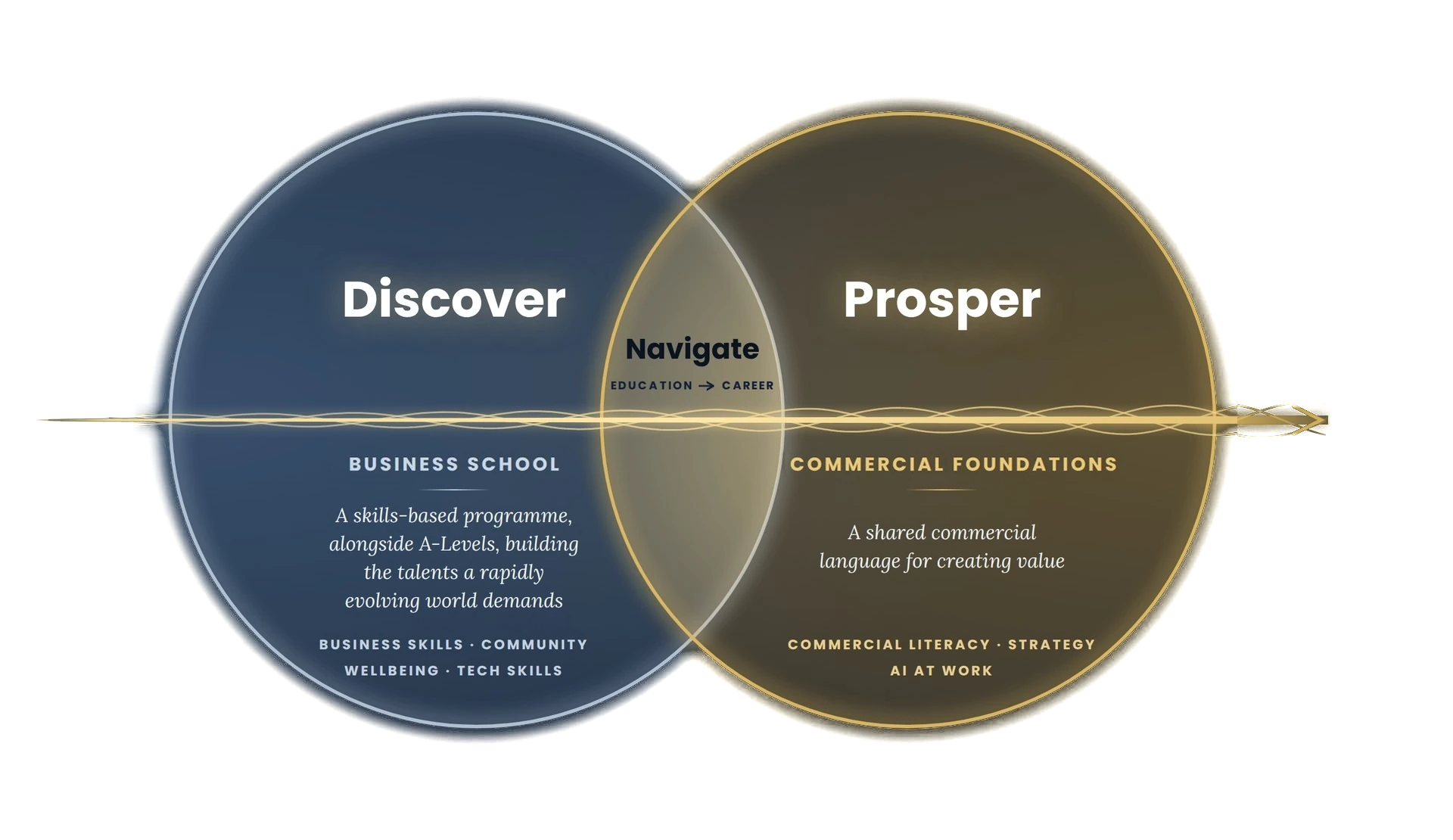
Why Resalico works on the move from education to career, and what we build there.
In education you are assessed. The work is set, the standard is published, and someone else marks it. At work you are accountable. Nobody sets the work, the standard is whatever the situation needs, and the consequence lands on you.
Being good at the first does not automatically prepare anyone for the second. That is not a criticism of schools or of graduates. It is simply a different kind of ask.
And it happens more than once: at a first job, at graduate intake, at a first promotion, at a move into an unfamiliar function, and every time the world shifts under a role, as AI is doing now.
The move from education to career is one of the most important transitions anyone makes. Resalico specialises in it.
Resalico’s position is inspired by John Krumboltz’s Planned Happenstance theory. Careers are rarely planned in a straight line, and the people who do well are the ones who turn unplanned events into opportunity.
It treats a change of plan as normal, not as failure. A course that closes, an offer that changes, a role reshaped by new technology: these are the conditions people are walking into, in the sixth form and in a first job.
So the question is not how to pick the perfect path. It is how to give people enough self-knowledge and business understanding to steer well when the path moves.
Plans change. Resalico gives people the business compass to steer by when they do.
Select Discover for schools, or Prosper for business.
Finding out where your strengths and interests lie, and how organisations really work.
The move from education to career. Choosing a direction you can defend, and adjusting when things change.
Thriving where you are, and adding value to the people and organisations around you.
Business knowledge, the confidence to debate it, and a clearer sense of which way to go. It starts in the sixth form, when a student first meets the world of organisations, and is carried into every new role. It is built through six skills, and each audience meets them in its own setting.
| Skill | In the sixth form | In the workplace |
|---|---|---|
| Enterprise awareness | Understands how every kind of organisation works: private, public, charity and social enterprise | Understands how value is created, measured and shared |
| AI at work | Uses AI well and safely to learn and to decide | Works productively with AI, with judgement |
| Curiosity | Explores options before choosing | Learns any tool or function fast |
| Adaptability | Copes when the plan changes: grades, courses, offers | Handles change and ramps up faster |
| Judgement | Makes a choice they can defend | Decides without escalating |
| Confidence | Debates a business idea, and walks into interviews with evidence | Speaks up in the budget meeting |
Our view of business is stakeholder, not shareholder only. Organisations create value for customers, colleagues, communities and owners, and profit is one measure of that value, not the whole of it.
That is why our programmes cover private, public, charity and social enterprise organisations. The numbers stay rigorous: measuring value is where the P&L, cash and KPIs live.